
Coming to the Lord's Table Together
As we have discussed over the course of our series on liturgy and as will be introduced in Sunday’s sermon, we are making some changes to our communion elements and how they will be distributed in the worship service. Starting on Easter Sunday (April 5), we will have communion wine and freshly baked bread (while still having unfermented grape juice and gluten/dairy free bread, too). The reasons for bread and wine can be seen in last week’s blog post and will be revisited in this week’s sermon. Needless to say, this change is not simply a matter of personal preference, but one of theological import.
We believe bread and wine best symbolize the Lord’s body and blood, and we believe that these elements are preferable for representing our Lord as we come to the Table. Still, with the change of elements come a change in their distribution. And that is what I want to share here, complete with a (s)eating chart.
Here are ten things you need to know as you prepare for the Lord’s Supper in just a few days:
1. The Elements. All elements will be kept in the front of the sanctuary. So there are no elements to pick up before service. These elements will be bread and wine, along with grape juice and gluten/dairy free bread.
2. Timing. Elements will be made available after the sermon and after an introduction to the Lord’s Table. Members will then be invited forward to pick up the elements and return to their seats.
3. Fencing the Table. As before, “fencing the table” is a simple instruction for the way that communion is for church members and for guests who have also been baptized in Christ. (We do not restrict paedobaptists, worshipers who come from gospel-believing Presbyterian churches, from the Lord’s Table).
4. Confession of Faith. After the Lord’s Supper is introduced, we will confess our faith together. This confession will come by reciting the Apostles Creed, the Nicene Creed, or some other statement of our faith. We have confessed these statements in service before, but not before the Lord’s Table.
5. Music and Ushers. Following this confession, the musicians will begin to play instrumentally, while our ushers dismiss the rows to pick up the elements, starting with the front rows, and moving backward. As each Sunday will have different numbers and distribution of people, this will require some flexibility and patience. If you are not sharing in the Lord’s Table, please feel free to remain seated, though you might need to get up briefly to let someone in or out of your row.
6. The Table. You will find the bread (regular or gluten/dairy free) and the cup (wine or grape juice) clearly marked on the table. Each table will be served by an elder. If any questions arise, they are there to assist. Pick up the bread and the cup and return to your seat, and we will take them together as we always have done.
7. Expected Challenges. We understand the challenges of having small children or other complicating factors. If we find repeated problems, we will address those. But we believe the best solution is for members and their families to patiently assist one another in moving to the Table and picking up the elements. In cases where someone is unable to walk to the front, we will make arrangements to bring the elements. Additionally, when someone in your row does not take communion, whether that is an unbaptized child or a visitor, we are suggesting they remain seated or simply exit the row and then return to their seat, while those getting communion walk up a center aisle to the tables.
We believe bread and wine best symbolize the Lord’s body and blood, and we believe that these elements are preferable for representing our Lord as we come to the Table. Still, with the change of elements come a change in their distribution. And that is what I want to share here, complete with a (s)eating chart.
Here are ten things you need to know as you prepare for the Lord’s Supper in just a few days:
1. The Elements. All elements will be kept in the front of the sanctuary. So there are no elements to pick up before service. These elements will be bread and wine, along with grape juice and gluten/dairy free bread.
2. Timing. Elements will be made available after the sermon and after an introduction to the Lord’s Table. Members will then be invited forward to pick up the elements and return to their seats.
3. Fencing the Table. As before, “fencing the table” is a simple instruction for the way that communion is for church members and for guests who have also been baptized in Christ. (We do not restrict paedobaptists, worshipers who come from gospel-believing Presbyterian churches, from the Lord’s Table).
4. Confession of Faith. After the Lord’s Supper is introduced, we will confess our faith together. This confession will come by reciting the Apostles Creed, the Nicene Creed, or some other statement of our faith. We have confessed these statements in service before, but not before the Lord’s Table.
5. Music and Ushers. Following this confession, the musicians will begin to play instrumentally, while our ushers dismiss the rows to pick up the elements, starting with the front rows, and moving backward. As each Sunday will have different numbers and distribution of people, this will require some flexibility and patience. If you are not sharing in the Lord’s Table, please feel free to remain seated, though you might need to get up briefly to let someone in or out of your row.
6. The Table. You will find the bread (regular or gluten/dairy free) and the cup (wine or grape juice) clearly marked on the table. Each table will be served by an elder. If any questions arise, they are there to assist. Pick up the bread and the cup and return to your seat, and we will take them together as we always have done.
7. Expected Challenges. We understand the challenges of having small children or other complicating factors. If we find repeated problems, we will address those. But we believe the best solution is for members and their families to patiently assist one another in moving to the Table and picking up the elements. In cases where someone is unable to walk to the front, we will make arrangements to bring the elements. Additionally, when someone in your row does not take communion, whether that is an unbaptized child or a visitor, we are suggesting they remain seated or simply exit the row and then return to their seat, while those getting communion walk up a center aisle to the tables.
- If you’re seated in a side row, you will walk up a center aisle (see green arrows on the floorplan below), and return to your seats by the side aisle.
- If you’re seated in a center row, you will also walk up a center aisle (see green arrows on the floorplan below) and return to your seats by the same center aisle.
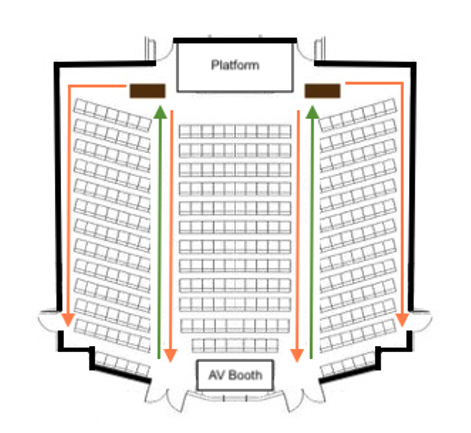
8. Singing. As our congregation processes to get the elements, the musicians will lead us in a communion hymn. As the congregation comes back to their seats and the song finishes, we will take the meal together.
9. The Communion. The pastor officiating the communion meal will pray and give instructions for the congregation to take the bread and then the cup.
10. The Overall Effect. While we expect that these changes will take a little more time in service, we seek to glorify the Lord in this and we believe it is worthwhile. For not only do we honor our Lord by taking bread and wine/juice, but the slower communion meal gives us time to offer prayers of thanksgiving to God for his Son and for the body of Christ who has been assembled by his finished work on the cross.
Finally, for those who might have any remaining questions, we will run through this together on Sunday evening, March 29, when we come together for our members meeting. On that night, we will enjoy a fellowship meal downstairs and then we will take communion together in the sanctuary with the new communion elements and distribution. Additionally, we will troubleshoot any logistical challenges or questions that arise. Until then, if you have further questions, please share them with your community group (who will be discussing the Lord’s Supper this week) or with any elder.
We are delighted to be able to look for ways to better apply God’s Word, and we truly believe that taking the communion elements in this way affords us the opportunity to do that.
For His Glory and your joy,
Pastor David
9. The Communion. The pastor officiating the communion meal will pray and give instructions for the congregation to take the bread and then the cup.
10. The Overall Effect. While we expect that these changes will take a little more time in service, we seek to glorify the Lord in this and we believe it is worthwhile. For not only do we honor our Lord by taking bread and wine/juice, but the slower communion meal gives us time to offer prayers of thanksgiving to God for his Son and for the body of Christ who has been assembled by his finished work on the cross.
Finally, for those who might have any remaining questions, we will run through this together on Sunday evening, March 29, when we come together for our members meeting. On that night, we will enjoy a fellowship meal downstairs and then we will take communion together in the sanctuary with the new communion elements and distribution. Additionally, we will troubleshoot any logistical challenges or questions that arise. Until then, if you have further questions, please share them with your community group (who will be discussing the Lord’s Supper this week) or with any elder.
We are delighted to be able to look for ways to better apply God’s Word, and we truly believe that taking the communion elements in this way affords us the opportunity to do that.
For His Glory and your joy,
Pastor David
Recent
A Call to Prayer and Fasting this Election Day
October 23rd, 2026
First Principles for Bible Reading
October 15th, 2026
The Beginning of the Priesthood: Revisiting Levi in Genesis 34
September 30th, 2026
Who Needs Virtue? You Do!
September 16th, 2026
Why Study the Protestant Reformation and Why Does It Matter?
September 10th, 2026
Archive
2026
January
February
March
April
May
June
July
August
September
2025
January
April
August
September
November
2024
April
May
August
November
2023
February
September
2022
February
April
September
2021